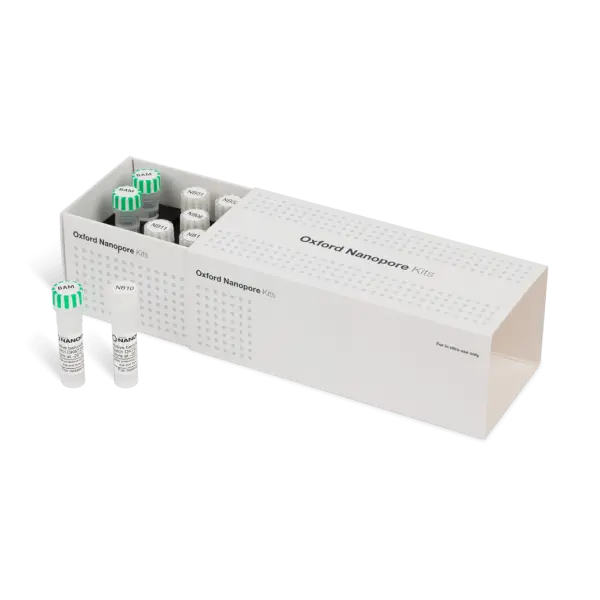
This kit is recommended for users who:
Please note that to use this kit, you will need to purchase additional 3rd party reagents: see the “3rd Party Materials” tab for more detail.
Barcoding or multiplexing is useful when the amount of data required per sample is less than the total amount of data that can be generated from a single flow cell: it allows a user to pool multiple samples and sequence them together, making more efficient use of the flow cell.
*Multiplexing samples onto one flow cell can reduce the cost per sample for a user.
| Feature | Property |
|---|---|
| Preparation time | 140 minutes |
| Input requirement | • 400 ng per sample of gDNA
• 200 fmol (130 ng for 1 kb amplicons) per sample of amplicons |
| PCR Required | No |
| Fragmentation | Optional |
| Kit chemistry | Kit 14 (V14) |
| Read length | Equal to fragment length |
| Associated protocols | • Ligation Sequencing gDNA – Native barcoding kit 96 V14
• Ligation Sequencing amplicons – Native barcoding kit 96 V14 • Ligation sequencing influenza whole genome V14 (SQK-NBD114.24 or SQK-NBD114.96) |
| Pack size | Up to 12 reactions:
Options: 3 libraries containing 96 barcodes, 6 libraries containing 48 barcodes or 12 libraries containing 24 barcodes |
| Stability | Shipped at 2–8°C
Long-term storage -20°C The warranty for this Early Access product is 3 months from receipt by the customer |
The Native Barcoding Kit 96 V14 is a standalone kit providing 96 unique barcodes to enable PCR-free multiplexing of dsDNA samples such as gDNA and amplicons.
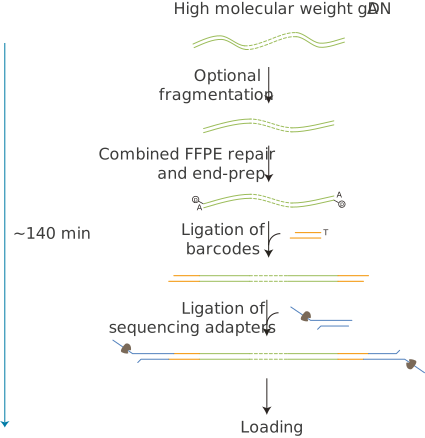
The library preparation method is similar to the Ligation Sequencing Kit protocol; gDNA is repaired (note: DNA repair is skipped when using amplicon input) and dA-tailed using the NEBNext End Repair/dA-tailing module, and then a unique dT-tailed barcode adapter is ligated on the dA-tailed template. Barcoded samples are then pooled together. Each barcode adapter also has a cohesive end and this is used as a hook to ligate to the supplied sequencing adapter.
The kit is optimised to achieve modal sequencing accuracies of over 99% (Q20+) with high output on our latest nanopore: R10.4.1. Our flow cell priming and sequencing reagents have been reformulated to be compatible with this improved Kit 14 adapter and R10.4.1 nanopore.
Kit 14 also includes previous updates such as the higher capture rate of DNA to enable lower flow cell loading amounts, and fuel fix technology, allowing users to run longer experiments without the need for fuel addition during the run.
If your experiment requires long reads, it is recommended to start with full-length gDNA, and fragmentation/shearing is neither advised nor required. Note: If long reads are required, high molecular weight DNA should be used as input. To determine purity, we suggest using the Nanodrop to measure the A260/280 and A260/230 ratios and we recommend that the sample should meet the following criteria:
The Native Barcoding Kit 96 V14 is compatible with upstream processes such as whole genome amplification (for applications where under 1 ng of sample is available) and size selection (for enrichment of specified fragment lengths, for example, using our Short Fragment Eliminator Kit (EXP-SFE001)). When size selecting, we recommend increasing the amount of input used, as size selection can be a wasteful process.
Deconvolution of barcoded sequencing data is supported by MinKNOW, Guppy and EPI2ME which classify the barcode sequence and sort reads into corresponding folders.
Starting with lower amounts of input material, or impure samples can affect library preparation efficiency and lower sequencing output. PCR can be used to generate more input material in cases where sample amount is limiting.
Flow cells and kits are shipped together in an environmentally friendly temperature-controlled shipping box.
Products are shipped to customers within the USA and EU Monday to Thursday. Shipments to Canada, Norway, Korea and Japan are expedited Monday to Wednesday; with Australia and New Zealand leaving our warehouses on a Friday. Shipments to the rest of the world are made on Mondays to allow the full working week for packages to arrive.
The delivery charges are calculated when a quote is raised or during checkout. Once an order is made, the delivery ID and delivery information can be tracked in the Store.
The library preparation method is similar to the Ligation Sequencing Kit protocol; gDNA is FFPE repaired (note: DNA repair is skipped when using amplicon input) and end-prepped/dA-tailed using the NEBNext End Repair/dA-tailing module. A unique dT-tailed barcode adapter is then ligated on the dA-tailed template. Barcoded samples are pooled together. Each barcode adapter also has a cohesive end which is used as a hook to ligate to the supplied sequencing adapter.
To access the protocol, you will need to register for a Nanopore Community account.
Safety and Data Sheet for Native Barcoding Kit 96 V14 (SQK-NBD114.96) with higher concentration EDTA
Safety Data Sheet for Native Barcoding Kit 96 V14 (SQK-NBD114.96) with reduced concentration EDTA
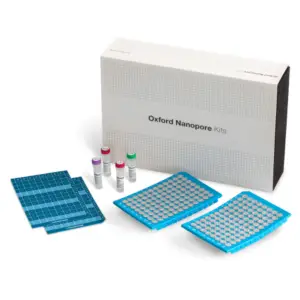
The Native Barcoding Kit 96 V14 contains 96 unique barcodes and sufficient reagents for up to 12 reactions.
Note: Our kits have been updated with reduced EDTA concentration.
Reduced EDTA concentration format (current):
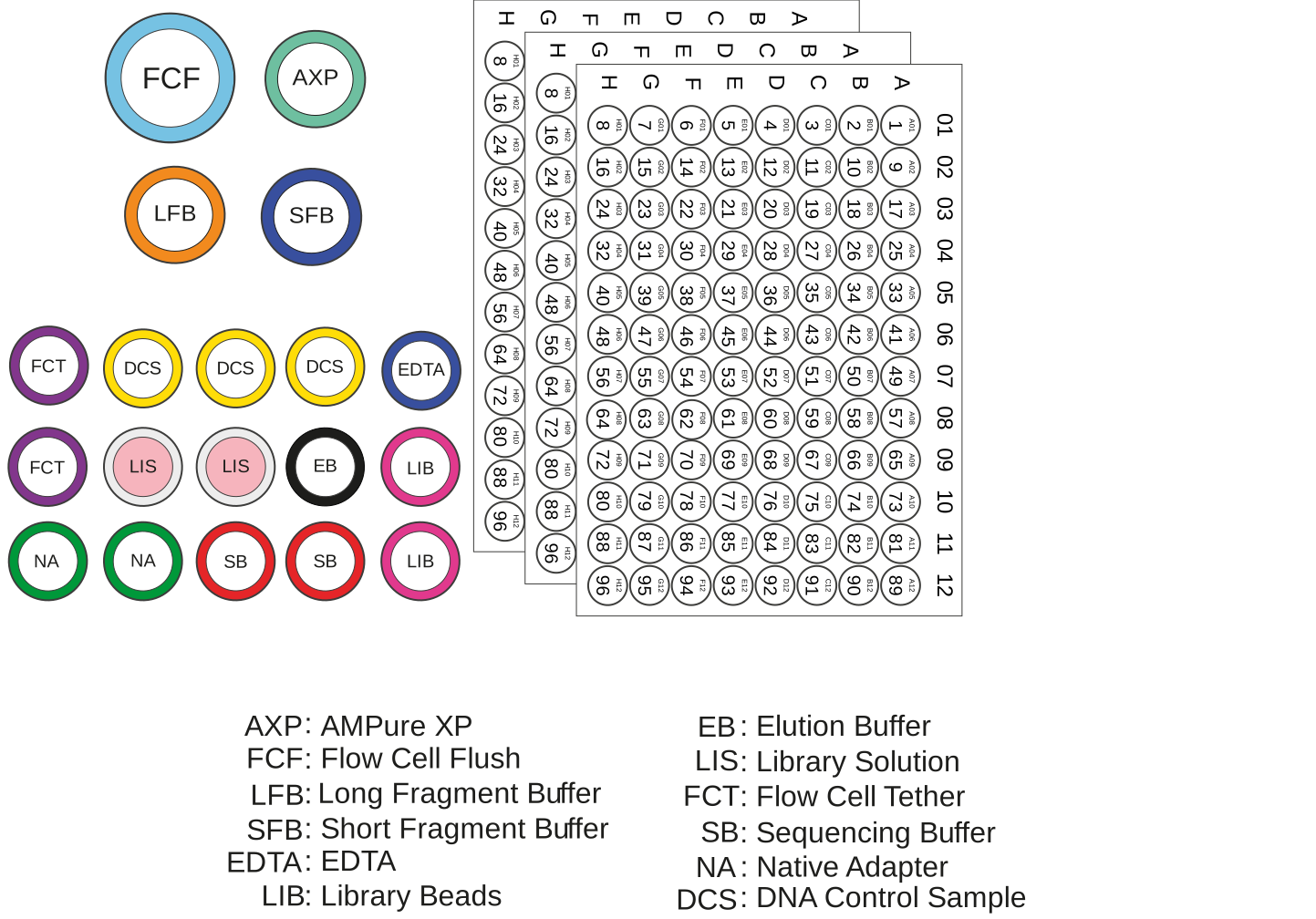
| Name | Acronym | Cap colour | No. of vials | Fill volume per vial (µl) |
|---|---|---|---|---|
| Native Barcode plate | NB01-96 | – | 3 plates | 8 µl per well |
| DNA Control Sample | DCS | Yellow | 3 | 35 |
| Native Adapter | NA | Green | 2 | 40 |
| Sequencing Buffer | SB | Red | 2 | 700 |
| Library Beads | LIB | Pink | 2 | 600 |
| Library Solution | LIS | White cap, pink label | 2 | 600 |
| Elution Buffer | EB | Black | 1 | 1,500 |
| AMPure XP Beads | AXP | Clear cap, light teal | 1 | 6,000 |
| Long Fragment Buffer | LFB | Clear cap, orange label | 1 | 7,500 |
| Short Fragment Buffer | SFB | Brown cap, dark blue label | 1 | 7,500 |
| EDTA‡ | EDTA | Blue | 1 | 700 |
| Flow Cell Flush | FCF | Clear cap, light blue label | 1 | 15,500 |
| Flow Cell Tether | FCT | Purple | 2 | 200 |
‡ Reduced concentration of EDTA with a blue cap.
Note: This Product Contains AMPure XP Reagent Manufactured by Beckman Coulter, Inc. and can be stored at -20°C with the kit without detriment to reagent stability.
Note: The DNA Control Sample (DCS) is a 3.6 kb standard amplicon mapping the 3′ end of the Lambda genome.
Higher EDTA concentration format (old):
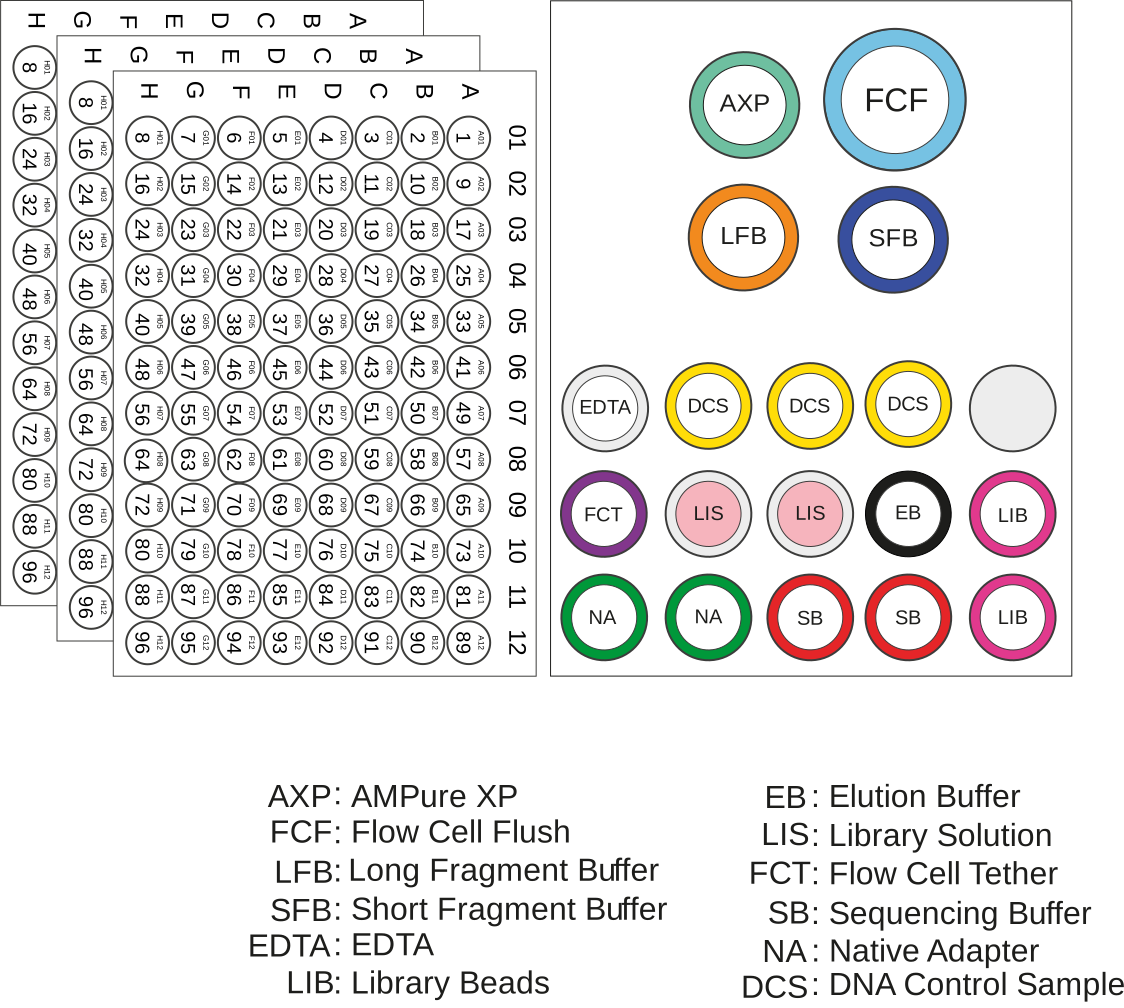
| Name | Acronym | Cap colour | No. of vials | Fill volume per vial (µl) |
|---|---|---|---|---|
| Native Barcode plate | NB01-96 | – | 3 plates | 8 µl per well |
| DNA Control Sample | DCS | Yellow | 3 | 35 |
| Native Adapter | NA | Green | 2 | 40 |
| Sequencing Buffer | SB | Red | 2 | 700 |
| Library Beads | LIB | Pink | 2 | 600 |
| Library Solution | LIS | White cap, pink label | 2 | 600 |
| Elution Buffer | EB | Black | 1 | 1,500 |
| AMPure XP Beads | AXP | Clear cap, light teal label | 1 | 6,000 |
| Long Fragment Buffer | LFB | Clear cap, orange label | 1 | 7,500 |
| Short Fragment Buffer | SFB | Brown cap, dark blue label | 1 | 7,500 |
| EDTA† | EDTA | Clear | 1 | 700 |
| Flow Cell Flush | FCF | Clear cap, light blue label | 1 | 15,500 |
| Flow Cell Tether | FCT | Purple | 2 | 200 |
† Higher concentration of EDTA with a clear cap.
The Native Barcoding Kit 96 V14 can be used together with:
R10.4.1.